Adaptations of Shakespeare
While teaching and directing at Highland High School in Salt Lake City, Newman adapted two of Shakespeare’s “Romance” plays for his students to perform. He first adapted The Winter’s Tale for his annual Shakespeare production. When he realized that he had enough strong freshmen that he could have cast the show with them, he created a shorter version of The Tempest for a mostly freshman cast and ran the two plays in repertory on the two-story, Elizabethan stage that they reconstructed each year. The last production he directed at Highland High, was appropriately enough, his adaptation of All’s Well that Ends Well. The first two adaptations are now published by Eldridge Plays. The third, All’s Well that Ends Well, is now published by Leicester Bay Theatricals.
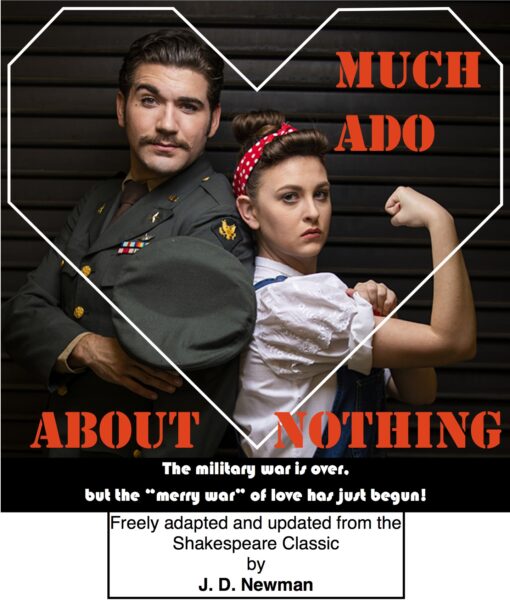
In Fall 2018, John Newman adapted and directed Shakespeare Much Ado About Nothing as a main season production at Utah Valley University. The script reset the story in a small town in Colorado in 1945 as the men were returning from World War II and male and female roles were being defined for the post-war era. This script is now published by Leicester Bay Theatricals.
THE WINTER’S TALE
Perhaps the richest and most poetic of Shakespeare’s lesser known plays, The Winter’s Tale begins with a jealous king who is obsessed with the groundless suspicion that his virtuous wife and faithful best friend are having an affair. None can convince the king of his erroneous judgment not prevent the tragic consequences of his mad jealousy. His daughter Perdita, who the king believes is illegitimate, is condemned by the king and only allowed to live when a servant offers to leave her in the woods rather than slaying her. After shaming the queen in a public trial and after denying the declaration of the Oracle of Delphi that the queen is chaste, the king loses everything he valued and loved. His daughter is lost, his son has died, and his wife is believed to have died of grief. Fast forward fourteen years when the king’s daughter, not knowing her identity, has falling in love with the son of the friend the king accused and banished. The plays switches gears from tragedy to pastoral comedy and back again, until through the miraculous workings of wise and faithful counselors, all that the grieving king has lost is miraculously restored. The adaptation runs about 90 minutes and can be cast with an ensemble of up to 26 with an even number of women and men.
THE TEMPEST
In Shakespeare’s last great play, the Duke of Milan, banished to a desert island with his daughter, commands his fairy servant to conjure a tempest to bring his usurping enemies to his shore and to exact his justice. Through the course of the play, the Duke’s daughter Miranda falls in love with the son of the king who consented to the Duke’s banishment. A trio of misfits (a drunken sea captain, a jester, and a monster) seek to destroy the Duke while the former conspirators plot against each other. In the end, the Duke offers mercy rather than exacting justice and, like the Bard himself, renounces his magic island and retires to ordinary life. The adaptation runs about 45 minutes and can be cast with an ensemble of eleven with more women than men.
ALL’S WELL THAT ENDS WELL
Helena, the daughter of a late physician, has been adopted by a Countess and has fallen in love with the Countess’s son Bertram. When Helena uses her father’s remedy to heal the ailing King of France, the king offers Helena Bertram’s unwilling hand in marriage as a reward. Bertram consents to be married but declares that Helena will never become his true wife until she is wearing his ring and bearing his child. Helena embarks on a pilgrimage on the trail of St. Jacques, during which she manages to accomplish the impossible and win the love of her faithless husband. The adaptation runs about 90 minutes and can be cast with an ensemble of eighteen with more women than men.
MUCH ADO ABOUT NOTHING
The military war is over, but the “merry war” of love has just begun! Considered one of Shakespeare’s most popular comedies, join Beatrice and Benedict, Hero and Claudio as they navigate through mine fields of words and jealous rivals to the safety of finding that one person with whom you truly belong. Drawing serious and frivolous into one realm, the show tells of nobleman Leonato, who shares his home with his daughter, Hero; niece, Beatrice; and elder brother, Antonio, as he welcomes friends home from the war. The play is set in 1945, just as WWII was coming to a close. A time in history where feminism had just experienced more progress than it ever had before. The Allies quickly realized that the only way to victory was to incorporate the efforts of as many citizens as possible. While men were being drafted to serve as soldiers, women were encouraged to take up jobs that had been previously deemed “man’s work”. They were working in factories building and fixing planes, working as conductors, and driving trucks and fire engines. And for the first time in history, women were officially recognized as part of the military. Traditional gender roles are confronted as women who went to work are finding that they are now expected to return home. The dark time of the war has finally passed. Women have been holding down the Homefront and the boys are returning to rejoin everyday life. And while some young men are looking forward to the romances in store, there are others who swear to never fall prey to the distractions of love. Beatrice, is a “Rosie the Riveter”-style hero with her sharp words and independent streak. Her rival-turned-lover, Benedick, is a returning war hero. Their friends determine to test their stubbornness and start a game of matchmaking and mischief that turns everyone’s world upside down. Benedick and Beatrice, who “never meet but there’s a skirmish of wit between them”, stand head to head and go toe to toe. The romantic tension is palpable and the clever banter sends sparks flying.
For scripts and royalties for the adaptations of The Winter’s Tale and The Tempest, contact Eldridge Plays at www.histage.com.
For scripts and royalties for the adaptation of All’s Well that Ends Well and Much Ado About Nothing, contact Leicester Bay Theatricals by following these links:
ALL’S WELL THAT ENDS WELL:
http://www.leicesterbaytheatricals.com/alls-well-that-ends-well-shakespeareedited/
MUCH ADO ABOUT NOTHING
https://www.leicesterbaytheatricals.com/?p=8093
 Newman Plays
Leave a comment